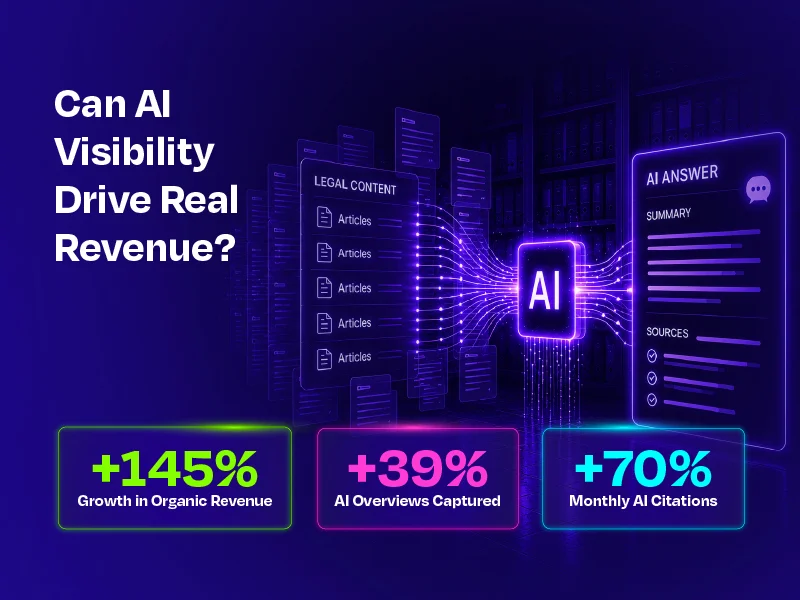
Organic Revenue Up 145% for a National Legal Nonprofit
Restructured content, entity schema, and AI discovery protocols grew citations in AI answers 70% and organic-attributed revenue 145% year over year.
Read More
SEO
Multi-Location Italian Restaurant Group
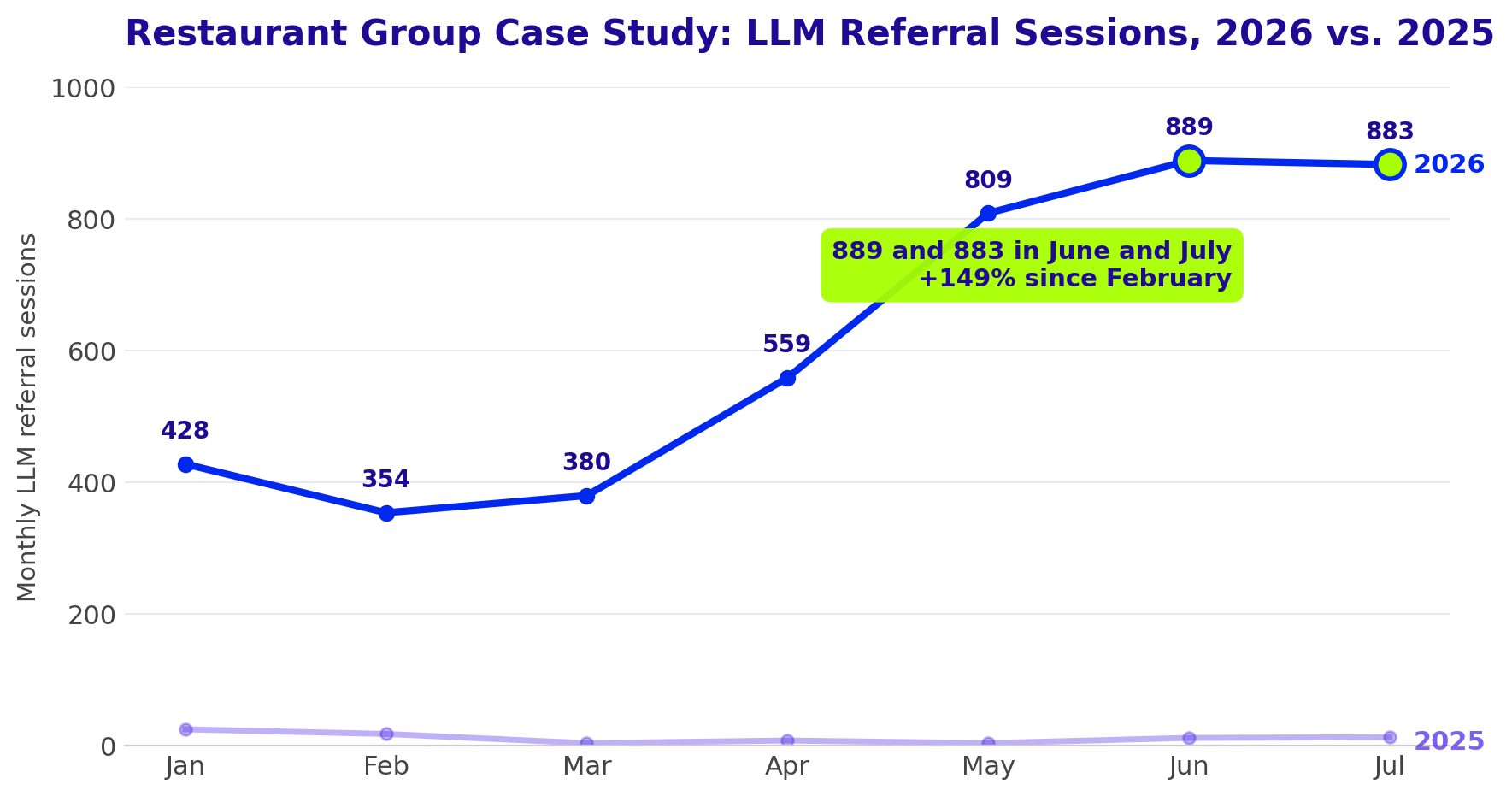
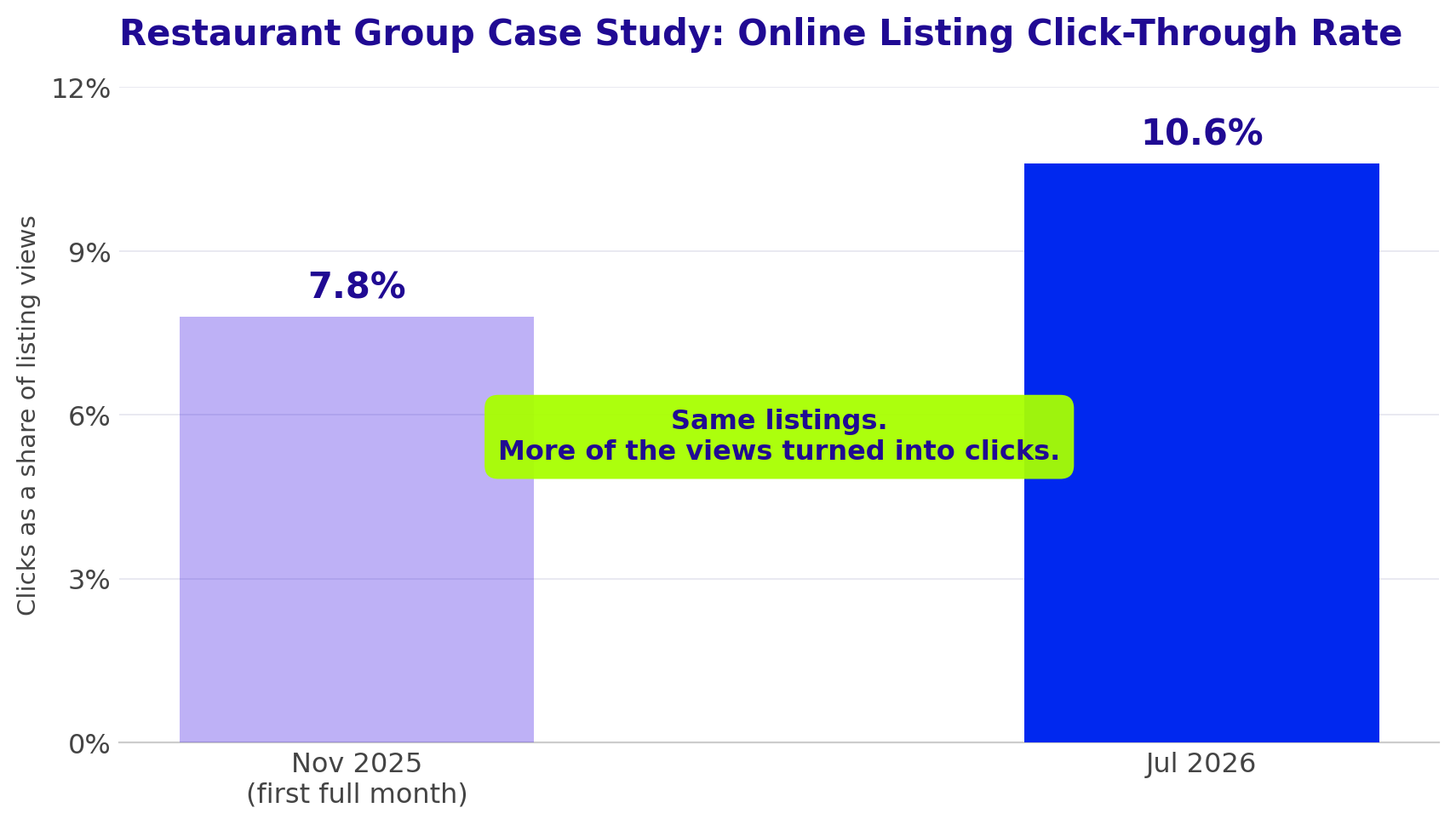
A multi-location Italian restaurant group partnered with Moving Traffic Media in October 2025 to strengthen its organic visibility and make its website easier for search engines and language models to understand. The work was foundational rather than AI-specific: accessibility, page structure, navigation, content clarity, metadata, internal linking across the location pages, consistent location signals between the site and Google Business Profiles, and a program to grow reviews across the group’s locations. Monthly referral sessions from large language models grew from 354 in February 2026 to 883 in July, a 149% increase — against a prior year in which the same channel never delivered more than 25 sessions in a month. Across February through July, calls from the group’s Business Profiles rose 27% year over year while total views fell slightly, and the group’s listings across every major directory lifted their click-through rate from 7.8% to 10.6%.
+149%
Monthly sessions from large language models rose from 354 in February 2026 to 883 in July, holding above 880 for two consecutive months. Across the same six months a year earlier, the channel delivered 59 sessions in total.
+36%
Across the group's listings on every major directory, clicks as a share of views rose from 7.8% in November 2025 to 10.6% in July 2026. The same listings converted a materially larger share of the people who saw them.
+27%
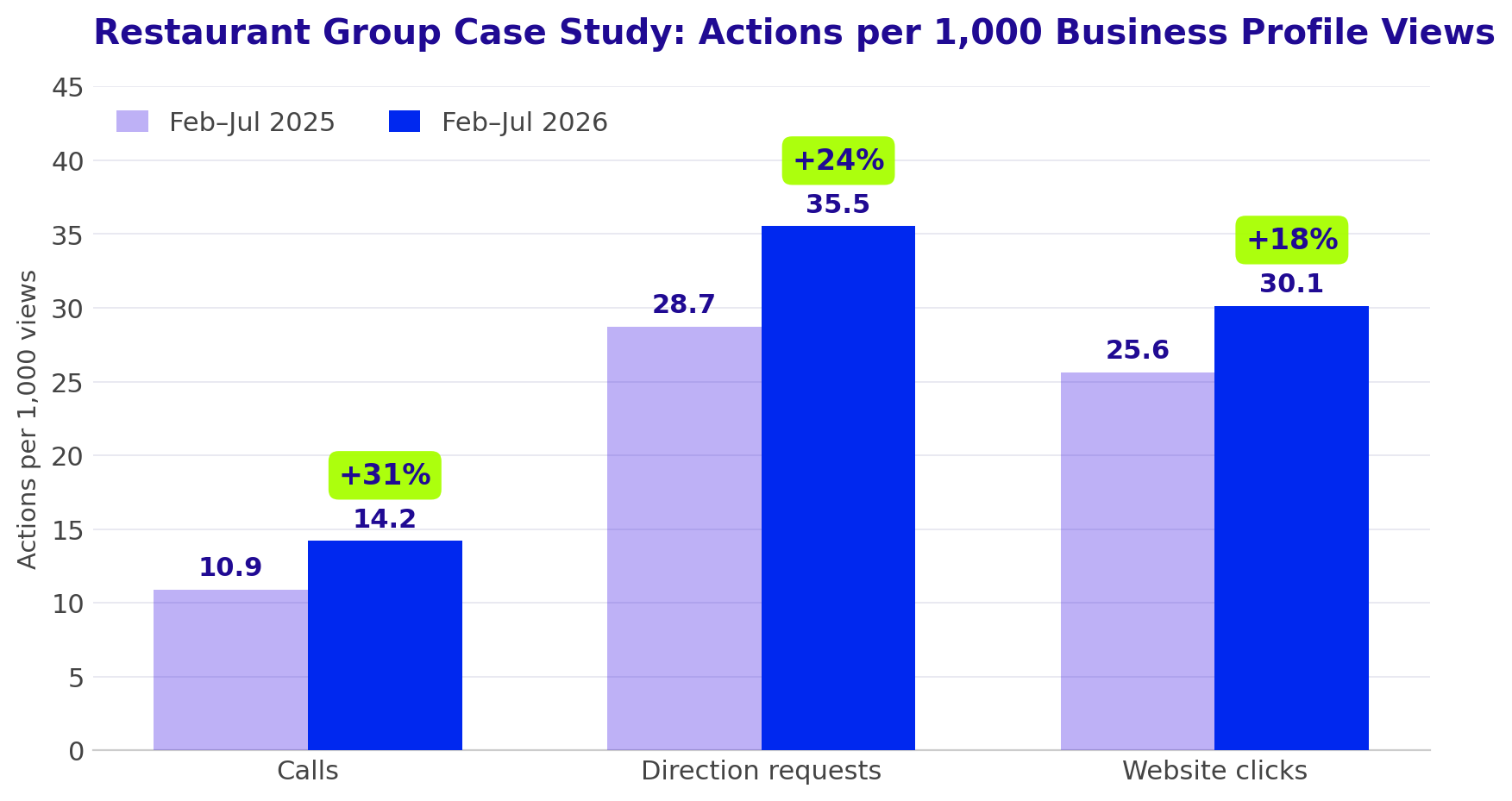
Calls placed directly from the group's Business Profiles rose 27% year over year across February through July, with direction requests up 20% and website clicks up 15%. Measured per profile view - the group's total views were flat to slightly down - calls rose 31%.

Service: SEO
Objective: Strengthen organic and AI visibility
KPI: LLM referral sessions, Business Profile actions
THE CHALLENGE:
For a restaurant group, almost every search is an operational question — and this group’s website did not answer those questions in a form machines could read.
Where are you. Are you open. Can I order pickup. Do you deliver. Do you ship. What happens if something arrives damaged. These are the questions people put to search engines and, increasingly, to AI assistants. They are not content marketing questions; they are facts, and they either exist on the page unambiguously or they do not.
Across the group’s site, they largely did not. Page structure and navigation made it difficult to determine what any given page was about. Content describing pickup, delivery, shipping, and return terms was unclear or scattered. Accessibility gaps meant the underlying markup lacked the semantic structure that assistive technology and automated parsers both depend on. The location pages — the most commercially important template on any multi-location site — sat at the edge of the site with few internal links pointing at them. And location signals were inconsistent between the website and the group’s Google Business Profiles, leaving search engines to reconcile competing versions of the same facts.
The cost showed up in AI referral traffic, which was effectively nonexistent. In the first half of 2025, large language models sent the site between 4 and 25 sessions per month.
THE STRATEGY:
Moving Traffic Media treated accessibility and machine readability as the same problem — because for a site whose value is operational facts, they are.
The instinct with a hospitality site is to reach for content: more pages, richer descriptions, better storytelling. That work has its place, but it does not fix a site where a language model cannot determine which location a page describes or whether the business ships nationwide.
The program instead focused on removing ambiguity. Proper heading hierarchy, semantic landmarks, descriptive link text, and alt text are ADA compliance requirements; they are also precisely the signals a parser uses to determine what a page contains and how its parts relate. Doing that work once served both audiences, and it is why a foundational engagement produced AI visibility gains without a single AI-specific tactic.
The second decision was to treat the website and the Google Business Profiles as one system rather than two channels. A model asked whether a location is open, or whether it delivers, will encounter both sources. When they disagree, confidence drops and the answer gets hedged or sourced elsewhere. Aligning them was less glamorous than building new content and did considerably more work.
The third decision was to extend that logic past Google. A restaurant’s facts live on dozens of directories, maps apps, and aggregators, and language models draw on all of them rather than on Google alone. Managing that surface as one estate — and keeping reviews flowing across it — is what supplies the third-party corroboration a restaurant has in place of press coverage. At the start of the engagement, the group’s listings had received no updates at all.
DETAILS:
The engagement ran across six connected workstreams.
Accessibility and page structure. MTM remediated ADA compliance gaps across the site — heading hierarchy, semantic landmarks, link text, and alt text — and restructured navigation so the relationship between pages was explicit rather than implied. The same changes that made the site usable with a screen reader made it parseable by a machine.
Content clarity and new pages. Pickup, delivery, shipping, and return information was rewritten to state terms plainly and completely, in the places customers and crawlers would look for it. New pages were added to cover topics the site had left implicit, and metadata was optimized across the site so titles and descriptions described their pages specifically.
Location pages and internal linking. MTM rebuilt the individual location pages and added a nearby-locations carousel to each one, so every location page links to the others around it. On a multi-location site those pages typically sit at the edge of the architecture with a single path in from a directory listing. The carousel converted a flat list into a connected network, multiplying the internal links pointing at each location and raising crawl priority across the entire set.
Location signals on the website. Location information was standardized across the site so that each location resolved as a distinct, unambiguous entity rather than as a variation on a shared template.
Google Business Profile alignment. The group’s Business Profiles were strengthened and brought into agreement with the website — hours, services, ordering and delivery options, and location details stated identically in both places, so that neither search engines nor language models had to choose between conflicting sources.
Listings across the wider ecosystem. Beyond Google, MTM managed the group’s presence across the full set of directories, maps applications, and aggregators through a listings management platform. The listings had gone entirely unmaintained before the engagement — zero updates on record in the first full month. By July 2026, 5,497 listing updates had been made, correcting and completing the group’s information everywhere a search engine or language model might encounter it.
Review generation. MTM ran a program to grow the volume and recency of reviews across the group’s locations, building the body of third-party commentary that both local search rankings and language models draw on when recommending where to go.
THE RESULTS:
Referral traffic from large language models grew from a standing start, and the group’s Business Profiles converted attention into action at a materially higher rate.
Monthly LLM referral sessions rose from 354 in February 2026 to 883 in July, a 149% increase across the window. The gain held rather than spiked: June and July both landed above 880, two consecutive months at the new level rather than a single peak. The prior-year comparison is stark enough that a percentage misrepresents it — across the whole of February through July 2025, large language models sent the site 59 sessions. In July 2026 alone they sent 883.
Across the group’s Google Business Profiles, the pattern was not a simple lift in volume. It was a lift in conversion.
Comparing February through July year over year, total profile views fell 3% while every action metric rose. Calls grew 27%, direction requests 20%, and clicks through to the website 15%. Measured per profile view, which isolates the change from any shift in exposure, the same figures read as +31%, +24%, and +18%.
The profiles were not being seen by more people. They were persuading more of the people who saw them, which is what happens when hours, services, and ordering options stop being ambiguous.
The same pattern held across the wider listings estate. In November 2025, the first full month of the engagement, the group’s listings drew 816,873 views and 63,703 clicks — a click-through rate of 7.8%. By July 2026 that rate had reached 10.6%. Like the Business Profile figures, it is a ratio, so neither the season it was measured in nor the single location added along the way moves it. The listings simply converted a larger share of the people who saw them.
What changed in between is countable. The group’s listings had received no updates at all in November 2025. By July 2026 they had received 5,497.
That distinction matters for a restaurant group. Views are a vanity measure; calls, clicks, and direction requests are someone deciding to show up.
Restructured content, entity schema, and AI discovery protocols grew citations in AI answers 70% and organic-attributed revenue 145% year over year.
Read More
A January 2025 replatform launched without an SEO migration plan and visibility collapsed. Rebuilding discoverability grew crawled pages 11.8x and LLM sessions 190%.
Read More
MTM rebuilt Meta targeting around CRM-defined high-value leads, doubling a medical device company’s monthly lead volume and cutting CPL 49%. See how.
Read More

