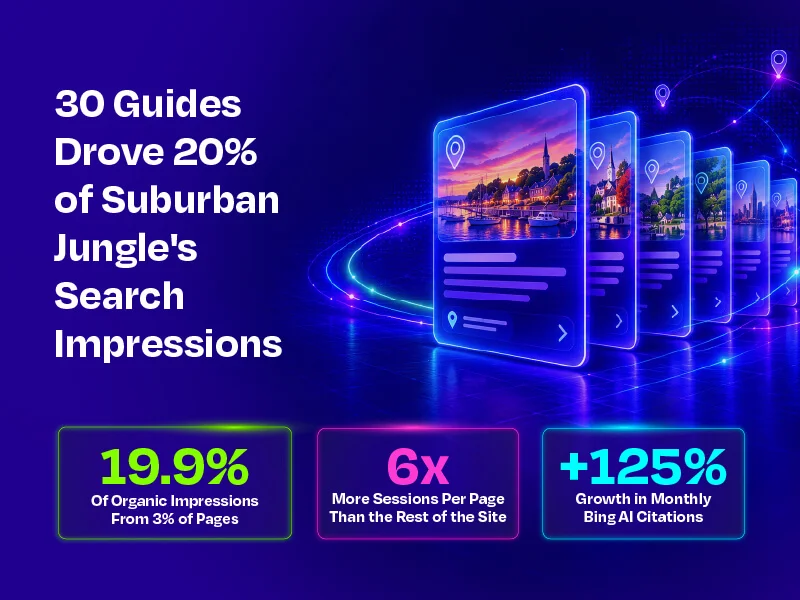
30 Guides Drove 20% of Suburban Jungle’s Search Impressions
MTM built 30 long-form city guides for Suburban Jungle that drew 19.9% of organic impressions from 2.8% of its URLs. See the strategy and results.
Read More
Paid Social
Multinational Medical Device Company
Moving Traffic Media manages paid social for a multinational medical device company whose Meta campaigns generate patient leads for a specialized treatment. Targeting built on standard platform segments had hit a ceiling: reach could only scale by paying more per lead. MTM rebuilt the audience strategy around the client’s own Salesforce CRM data — using first-party lead lists, segmented by funnel outcome, to power custom and lookalike audiences that matched the client’s definition of a high-value lead. Over four months, monthly lead volume grew 105% while cost per lead fell 49%.
+105%
Increase in Monthly Lead Volume: Monthly lead volume more than doubled within four months of launching CRM-powered custom and lookalike audiences on Meta.
−49%
Decrease in Cost Per Lead: Cost per lead was nearly cut in half over the same four-month period, so growth came from better targeting — not bigger budgets.

Service: Paid Social
Objective: Scale lead volume efficiently
KPI: Lead volume and cost per lead
THE CHALLENGE:
The client needed more leads from Meta without paying more for each one — and without letting quality slip. Their targeting relied on the standard interest and demographic segments available inside the platform, which meant Meta’s algorithm was optimizing toward its own generic definition of a lead, not the client’s definition of a valuable one.
That gap had a real cost. Broadening reach with platform segments alone tends to pull in lower-intent users, which pushes cost per lead up and lead quality down at exactly the moment a campaign is supposed to scale. The client needed a way to grow volume and hold efficiency at the same time.
THE STRATEGY:
The obvious move — raise budgets and widen the platform segments — would have bought volume at the expense of efficiency. MTM took a different path: teach Meta what a high-value lead actually looks like, using data the platform doesn’t have.
Moving Traffic Media worked directly with the client to define which leads held the most value to their business, drawing on outcomes recorded in their Salesforce CRM. Rather than treating all past leads as one signal, we distinguished between leads that qualified, leads that progressed, and leads that dropped off at different points in the funnel. Each of those groups tells Meta’s lookalike modeling something different — and seeding the algorithm with qualified leads, rather than all leads, points prospecting at the people most likely to become customers, not just form-fills.
DETAILS:
The client exported first-party lead data from Salesforce as CSV files, segmented by funnel outcome: past leads, leads that had qualified, and leads that had dropped off at defined funnel stages. MTM uploaded these lists into Meta as custom audiences.
From there, we built the targeting architecture in layers. The highest-value segments seeded lookalike audiences for prospecting, aligning Meta’s expansion modeling with the client’s own definition of a high-value lead. The custom audiences themselves supported more precise targeting and exclusion strategies — keeping spend focused on net-new, high-potential users instead of re-reaching leads already in the funnel.
The result was a feedback loop between the client’s CRM and Meta’s delivery system: business outcomes flowed back into the platform as audience signals, and the campaigns steadily optimized toward the leads that mattered.
THE RESULTS:
The CRM-powered audience strategy delivered scale and efficiency at the same time. Monthly lead volume grew 105% over four months — from roughly 2,000 Salesforce leads in Month 1 to 4,100 by Month 4 — while cost per lead fell 49% in the same period, dropping from $37 to $19 and holding at that level as volume climbed.
Lead quality improved alongside volume, because the targeting was seeded with the client’s qualified leads rather than generic platform segments. The durable outcome is bigger than one quarter’s numbers: the client now has a repeatable audience framework in which their own CRM data compounds — every new qualified lead makes the next round of targeting smarter.

MTM built 30 long-form city guides for Suburban Jungle that drew 19.9% of organic impressions from 2.8% of its URLs. See the strategy and results.
Read More
Clearer site structure, stronger content, reviews, and consistent location signals grew LLM referral sessions 149% and calls from Business Profiles 27%.
Read More
Restructured content, entity schema, and AI discovery protocols grew citations in AI answers 70% and organic-attributed revenue 145% year over year.
Read More

