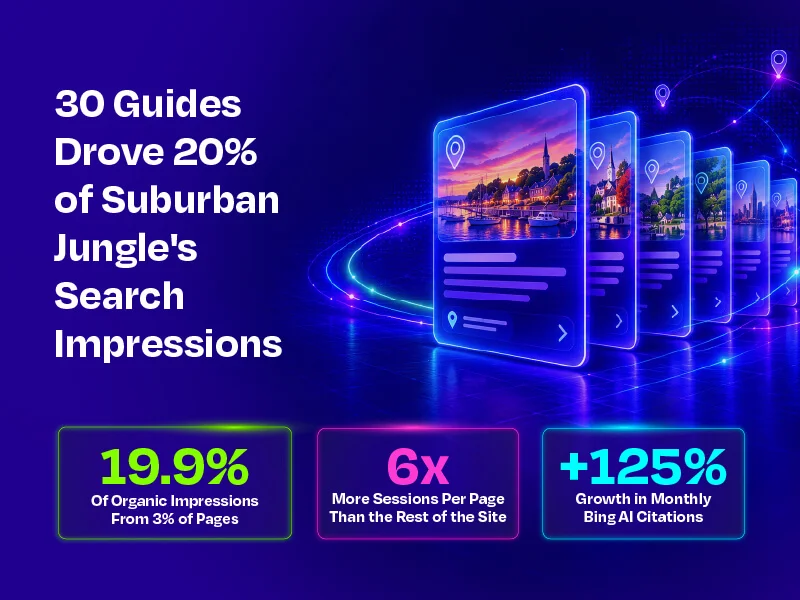
30 Guides Drove 20% of Suburban Jungle’s Search Impressions
MTM built 30 long-form city guides for Suburban Jungle that drew 19.9% of organic impressions from 2.8% of its URLs. See the strategy and results.
Read More
SEO
Global Legal & Regulatory Publisher
A global legal and regulatory publisher was losing organic ground on its e-commerce store: product and category pages had no H1 or H2 headings, almost no on-page text, no internal links, and a JavaScript-heavy CMS that search engines and LLMs struggled to read. Moving Traffic Media built an HTML snippet generator that injects structured headings, keyword-rich copy, and curated internal links directly into those pages. Within 30 days of the April 2025 launch, 73 keywords reached page one of Google — up from a single keyword — and by August, organic revenue had grown 79% year over year.
+79%
Year-over-Year Organic Revenue Growth: By August 2025, four months after launch, organic revenue was up 79% versus the same month the prior year.
+198%
Organic Clicks, Year One: Google Search Console clicks grew 198% comparing April 2026 with April 2025, the launch month — with impressions up 767% over the same period.
291
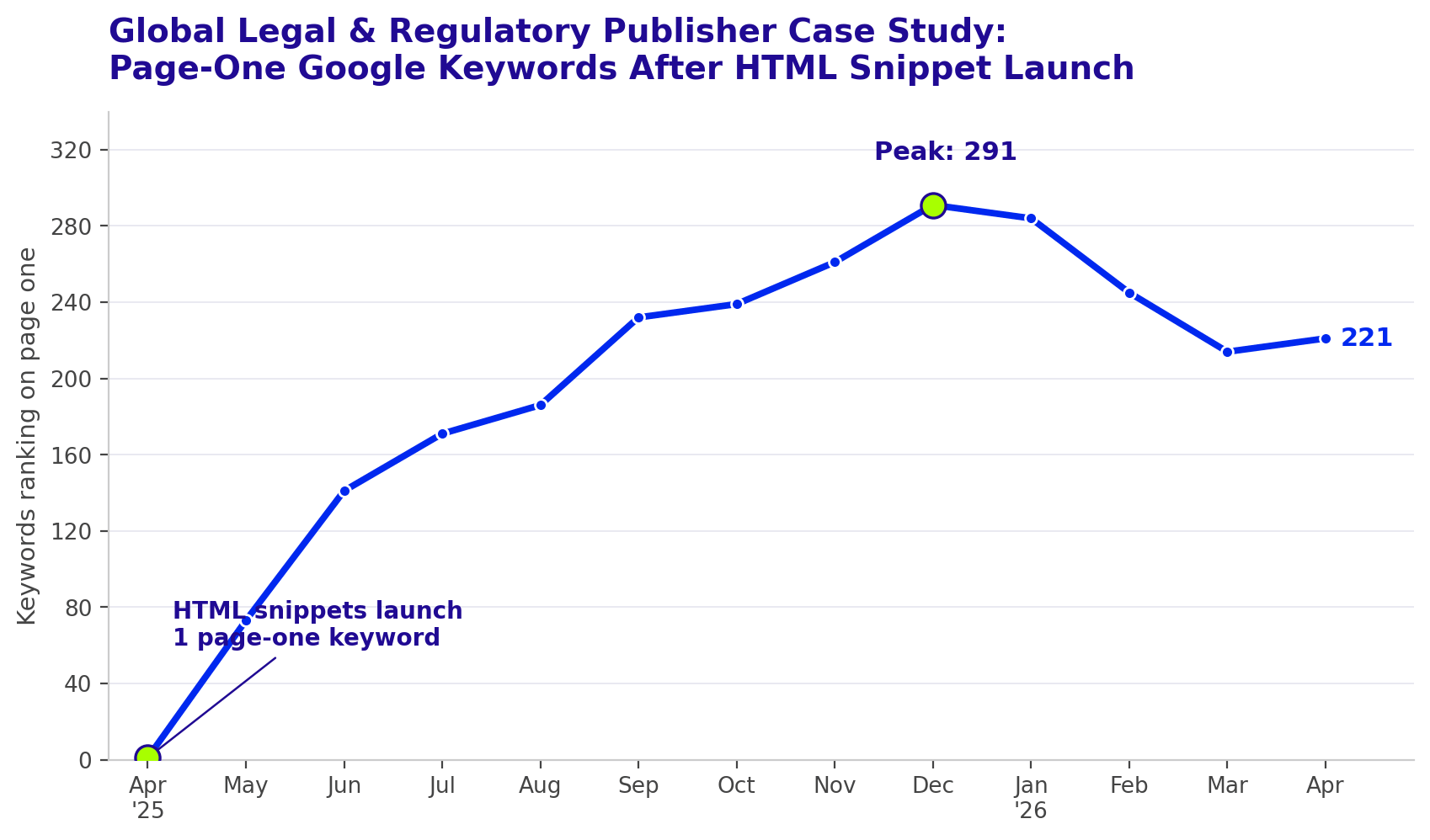
Page-One Keywords at Peak: From a single page-one keyword at launch, first-page rankings compounded to a peak of 291 in December 2025, holding above 200 a full year later.
12 Mos
of LLM Revenue Surpassed in One Month: LLM-attributed revenue in August 2025 alone exceeded the prior 12 months combined, and LLM sessions were still growing 44% year over year in April 2026.

Service: SEO
Objective: Restore organic visibility and revenue on product and category pages
KPI: Page-one keyword rankings and organic revenue
THE CHALLENGE:
The publisher’s e-commerce store was structurally invisible to search. Its CMS relied heavily on JavaScript, making page content difficult for search engines and large language models to read. Product and category page templates carried almost no text, and many pages were missing H1 and H2 tags entirely — crawlers had little to work with when determining what a page was about.
The CMS also provided no way to add internal links to related product or category pages, so there was no mechanism to distribute link equity or target keyword variations with descriptive anchor text. The result: organic traffic growth had stalled, and almost no revenue was being attributed to LLM traffic sources at a moment when AI-driven referrals were becoming a real channel.
THE STRATEGY:
The obvious fix — replatforming the CMS — was slow, expensive, and out of scope. Instead, Moving Traffic Media designed a workaround that operated inside the CMS’s constraints: an HTML snippet generator that lets the team compile structured, SEO-optimized content into a single clean code block that drops directly into any product or category page.
The logic was simple. If the CMS couldn’t natively produce headings, textual depth, or internal links, MTM would generate all three externally as pre-styled HTML and inject them at the page level. That approach added the crawlable signals search engines needed without touching the platform’s underlying architecture — making it repeatable across the catalog rather than a one-off fix.
DETAILS:
The generator provides fields for an H1, an H2, and a keyword-rich category blurb, plus up to five links to related product pages and five to related category pages — each paired with optimized anchor text so both users and crawlers understand the relationship between pages. Once the fields are filled, the tool compiles everything into a ready-to-use HTML block with inline styles.
Implementation began on April 1, 2025 across 11 category pages, including Artificial Intelligence, Blockchain, Crypto & Digital Assets, Aerospace Law, Cybersecurity & Privacy, and Blue Chip collections. Snippets rolled out in batches through April and May, with each page gaining structured headings, descriptive copy, and a curated internal-link module in a single deployment.
Beyond the crawl signals, the snippets improved the pages for people: category pages that previously showed little more than a product grid now open with a clear heading, a short orientation paragraph, and direct paths to related products and categories.
THE RESULTS:
Rankings moved almost immediately. Within 30 days of the April 1, 2025 launch, 73 tracked keywords ranked on page one of Google, up from a single keyword before implementation. First-page rankings kept climbing from there — 141 by June, 186 by August — and peaked at 291 keywords in December 2025. A full year after launch, the store still held 221 page-one positions, settling into a durable 210–290 range through spring 2026.
Revenue followed. In August 2025, organic revenue grew 79% year over year, and LLM-attributed revenue for that single month exceeded the total from the previous 12 months combined — early validation that the added structure was making the catalog legible not just to Google, but to the answer engines driving a growing share of purchase decisions.
The year-one comparison confirmed the gains were durable, not a spike. Measured against April 2025 — the launch month, before the snippets had taken effect — organic clicks in April 2026 were up 198% and organic impressions were up 767% in Google Search Console. LLM sessions grew 44% over the same period, showing the AI-referral channel was still compounding a year in. Moving Traffic Media now applies the snippet framework as a standing part of the publisher’s SEO program, extending it to new categories as the catalog grows.
MTM built 30 long-form city guides for Suburban Jungle that drew 19.9% of organic impressions from 2.8% of its URLs. See the strategy and results.
Read More
Clearer site structure, stronger content, reviews, and consistent location signals grew LLM referral sessions 149% and calls from Business Profiles 27%.
Read More
Restructured content, entity schema, and AI discovery protocols grew citations in AI answers 70% and organic-attributed revenue 145% year over year.
Read More

